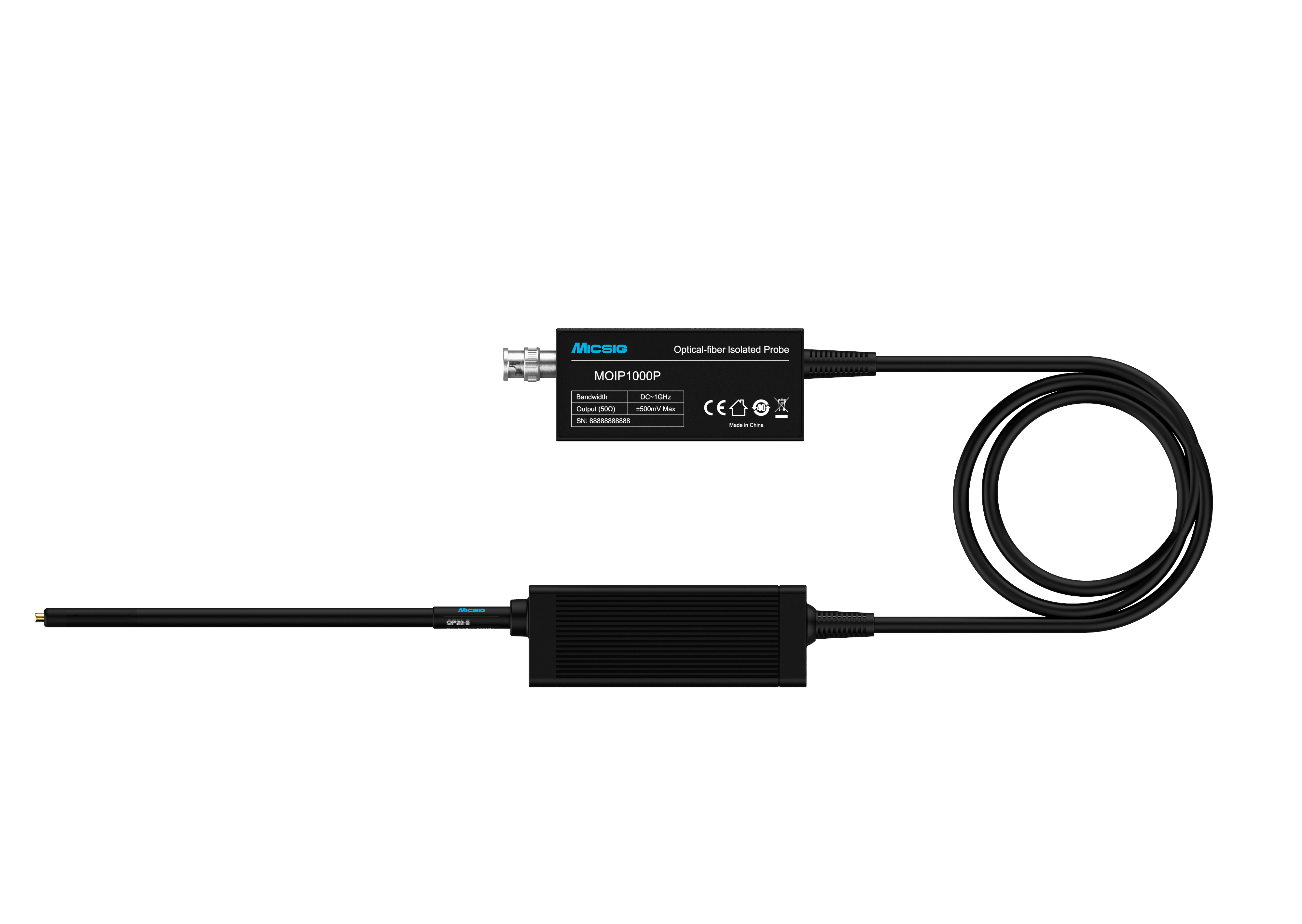
SigOFIT Gen 2 · MOIP100P to MOIP1000P
100 MHz to 1 GHz model options. The brochure lists up to 85 kVpk common-mode voltage range and attenuator-dependent differential measurement ranges up to ±6250 V.
Gen 2 details → · Open brochure PDF
Compare Micsig SigOFIT MOIP optical-fiber isolated probes for isolated differential voltage measurements. Explore Gen 2 and Gen 3 families, model bandwidth and attenuator-dependent voltage measurement ranges.
Request product guidanceMicsig SigOFIT MOIP probes transmit the measurement signal over optical fiber, electrically isolating the probe head from the instrument. The supplied Gen 2 and Gen 3 product PDFs describe model-specific bandwidth, common-mode rejection, noise and attenuator options.
100 MHz to 1 GHz model options. The brochure lists up to 85 kVpk common-mode voltage range and attenuator-dependent differential measurement ranges up to ±6250 V.
Gen 2 details → · Open brochure PDF
200 MHz to 1.2 GHz model options. The brochure describes attenuator-dependent differential ranges up to ±20 kV and up to 85 kV isolation voltage.
Gen 3 details → · Open brochure PDFCompare the target bandwidth, differential input range, attenuator compatibility, common-mode voltage, fiber length, output interface and required noise floor. Voltage measurement range depends on the selected attenuator; it is not the same value as the isolation rating.
The supplied brochures describe use in high-speed power electronics and third-generation semiconductor testing, including SiC and GaN switching measurements. Compare probe bandwidth and attenuator range against the signal you need to capture; refer to the exact MOIP model documentation for final specifications.
The measurement range depends on the attenuator and model. Do not treat the common-mode isolation voltage as the differential input range.